Writes a problem returned by importPEtab() back to PEtab: the parameter,
observable, condition and measurement tables, for v2 also the experiment
table, the SBML model and a YAML file. Conditions the importer split are
merged again. For a problem built in dMod, use exportPEtab().
Arguments
- petab
A
petabproblemreturned byimportPEtab(), or a list with the same components.- dir
Output directory, created if missing.
- modelID
SBML model identifier. Default
NULL: the model id of the imported problem, else"dMod_export".- formatVersion
"2.0.0"(default) or"1".- overwrite
Logical. If
FALSE(default), existing files indirare an error.
Details
Limits:
Parameter scales are read from
attr(petab$bestfit, "petab_scales"); without it they are"lin".v2 has no parameter scales: values and bounds are written on the linear scale, with a warning.
v2 has no priors on the parameter scale: such a prior is written as the matching prior of the linear parameter, with a warning.
v1 has no experiment periods, no start time other than 0 and fewer prior distributions: periods and later starts are an error, a prior without a v1 form gives a warning.
v2 has no
log10observable transformation: it is written as"log-normal"noise, with a warning.Initial values set per condition only in the parameter transformation are not written to a v2 condition table; use
formatVersion = "1"to keep them.SBML
<algebraicRule>elements are not imported and therefore not written.
Examples
# \donttest{
yaml <- system.file("extdata/petab_boehm/Boehm.yaml", package = "dMod2")
petab <- importPEtab(yaml, backend = "cppDE", cores = 1, outdir = tempdir())
#> Sparse Jacobian detected (8x8, 21 nnz, 67.188% sparse)
#> Sparse Jacobian detected (8x8, 21 nnz, 67.188% sparse)
#> using C++ compiler: g++
#> every source : -O2 -DNDEBUG -w -fPIC -DKLU -I/usr/include/suitesparse
#> 2 of 5 also : -DKLUBTF=0 -DKLUAMD=0 -fopenmp
petab
#> <PEtab problem Boehm>
#> source: /home/runner/work/_temp/Library/dMod2/extdata/petab_boehm/Boehm.yaml
#> conditions: 1 (1 sim, 0 preeq)
#> observables: pSTAT5A_rel, pSTAT5B_rel, rSTAT5A_rel
#> measurements: 48
#> bestfit (n=9): Epo_degradation_BaF3, k_exp_hetero, k_exp_homo, k_imp_hetero, k_imp_homo, k_phos, sd_pSTAT5A_rel, sd_pSTAT5B_rel, sd_rSTAT5A_rel
#> fixed (n=4): ratio, specC17, cyt, nuc
# The objective at the nominal values
petab$obj(petab$bestfit)$value
#> [1] 276.4441
# The prediction needs the fixed parameters
fixed <- attr(petab, "petab_meta")$fixed
times <- seq(0, 240, length.out = 61)
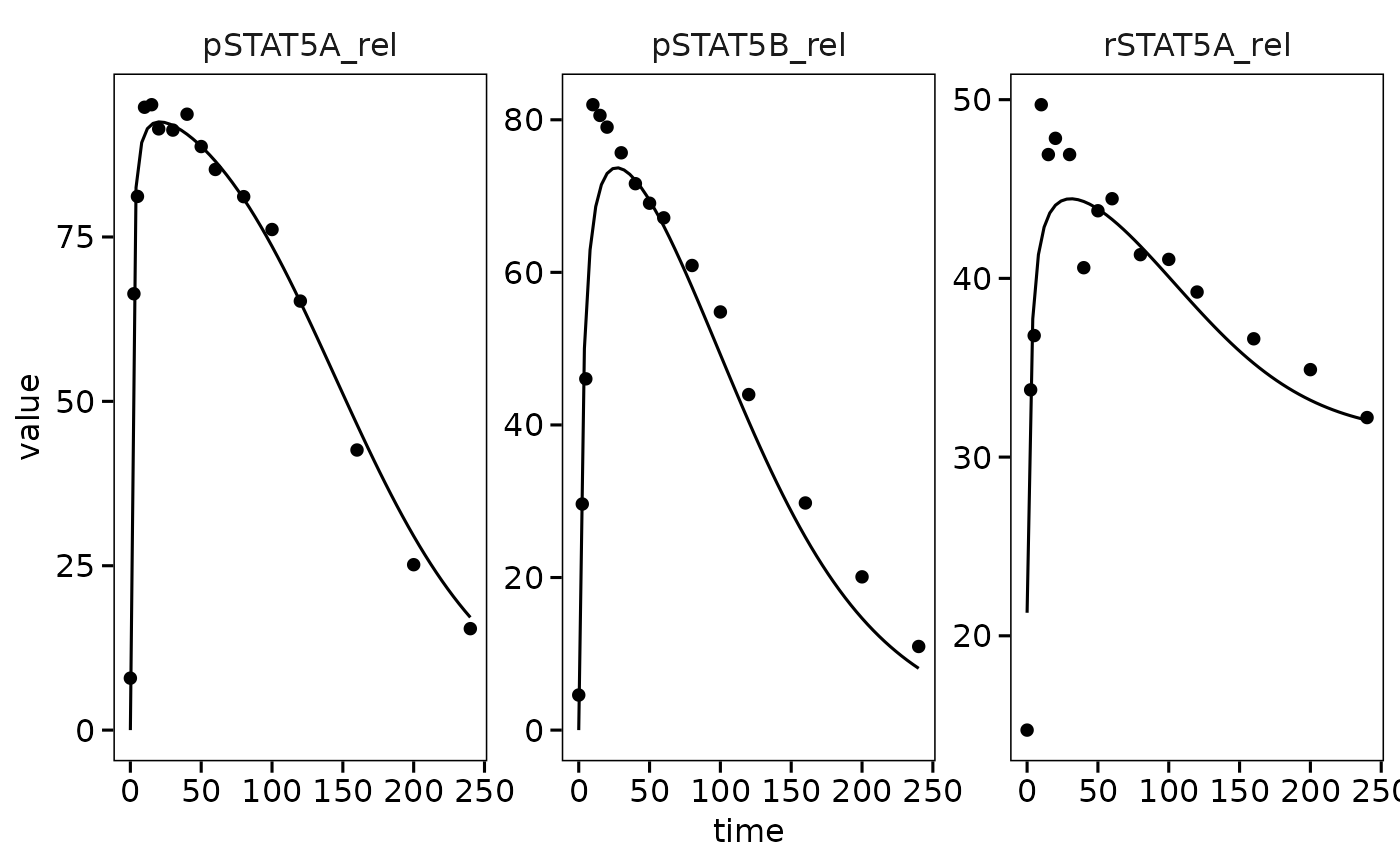
plot(petab$prd(times, c(petab$bestfit, fixed)), petab$dataList)
 # Write the problem back to PEtab
yamlOut <- exportPEtabObject(petab, file.path(tempdir(), "boehm"),
formatVersion = "1")
readPEtabTables(yamlOut)$parameters
#> parameterId parameterScale lowerBound upperBound nominalValue
#> 1 Epo_degradation_BaF3 log10 1e-05 1e+05 2.698251e-02
#> 2 k_exp_hetero log10 1e-05 1e+05 1.000680e-05
#> 3 k_exp_homo log10 1e-05 1e+05 6.170228e-03
#> 4 k_imp_hetero log10 1e-05 1e+05 1.636792e-02
#> 5 k_imp_homo log10 1e-05 1e+05 9.774938e+04
#> 6 k_phos log10 1e-05 1e+05 1.576651e+04
#> 7 sd_pSTAT5A_rel log10 1e-05 1e+05 3.852612e+00
#> 8 sd_pSTAT5B_rel log10 1e-05 1e+05 6.591478e+00
#> 9 sd_rSTAT5A_rel log10 1e-05 1e+05 3.152713e+00
#> 10 ratio lin -Inf Inf 6.930000e-01
#> 11 specC17 lin -Inf Inf 1.070000e-01
#> estimate
#> 1 1
#> 2 1
#> 3 1
#> 4 1
#> 5 1
#> 6 1
#> 7 1
#> 8 1
#> 9 1
#> 10 0
#> 11 0
# }