Concatenates observation functions, prediction functions and parameter
transformations: (e1 * e2)(times, pars) evaluates e2 first and passes
the output of e2 to e1.
Value
obsfn * obsfn and obsfn * parfn return an obsfn,
obsfn * prdfn and prdfn * parfn a prdfn, parfn * parfn a parfn
and objfn * parfn an objfn. Id() * f and f * Id() return f.
Details
A function defined for one condition combines only with one for
the same condition or for no specific condition (conditions = NULL); with
one for another condition or for several conditions it is an error.
Examples
## A prediction function interpolating parameter values piecewise linearly
times <- 0:5
grid <- data.frame(name = "A", time = times, row.names = paste0("p", times))
x <- Xd(grid)
## An observation function
g <- Y(c(Aobs = "s*A"), states = "A", parameters = "s",
modelname = "prediction_obs", outdir = tempdir())
#> Overwriting: /tmp/RtmpnLJd0N/prediction_obs.cpp
## One parameter transformation per condition
innerpars <- c(getParameters(x), getParameters(g))
trafo <- setNames(innerpars, innerpars)
p <- P(list(C1 = replaceSymbols(innerpars, paste0(innerpars, "_C1"), trafo),
C2 = replaceSymbols(innerpars, paste0(innerpars, "_C2"), trafo)),
modelname = "prediction_p", outdir = tempdir())
# \donttest{
## Compile the observation function and the transformations together
compile(g, p, output = "prediction_ex")
#> Warning: A shared library named 'prediction_ex' is already loaded; overwriting it is not portable. Using 'prediction_ex_6' instead.
#> using C++ compiler: g++ [-O2 -DNDEBUG -w -fPIC]
#> reusing 3 unchanged object(s)
outerpars <- getParameters(p)
pars <- setNames(seq(0.1, 1, length.out = length(outerpars)), outerpars)
## Unobserved states, then observables
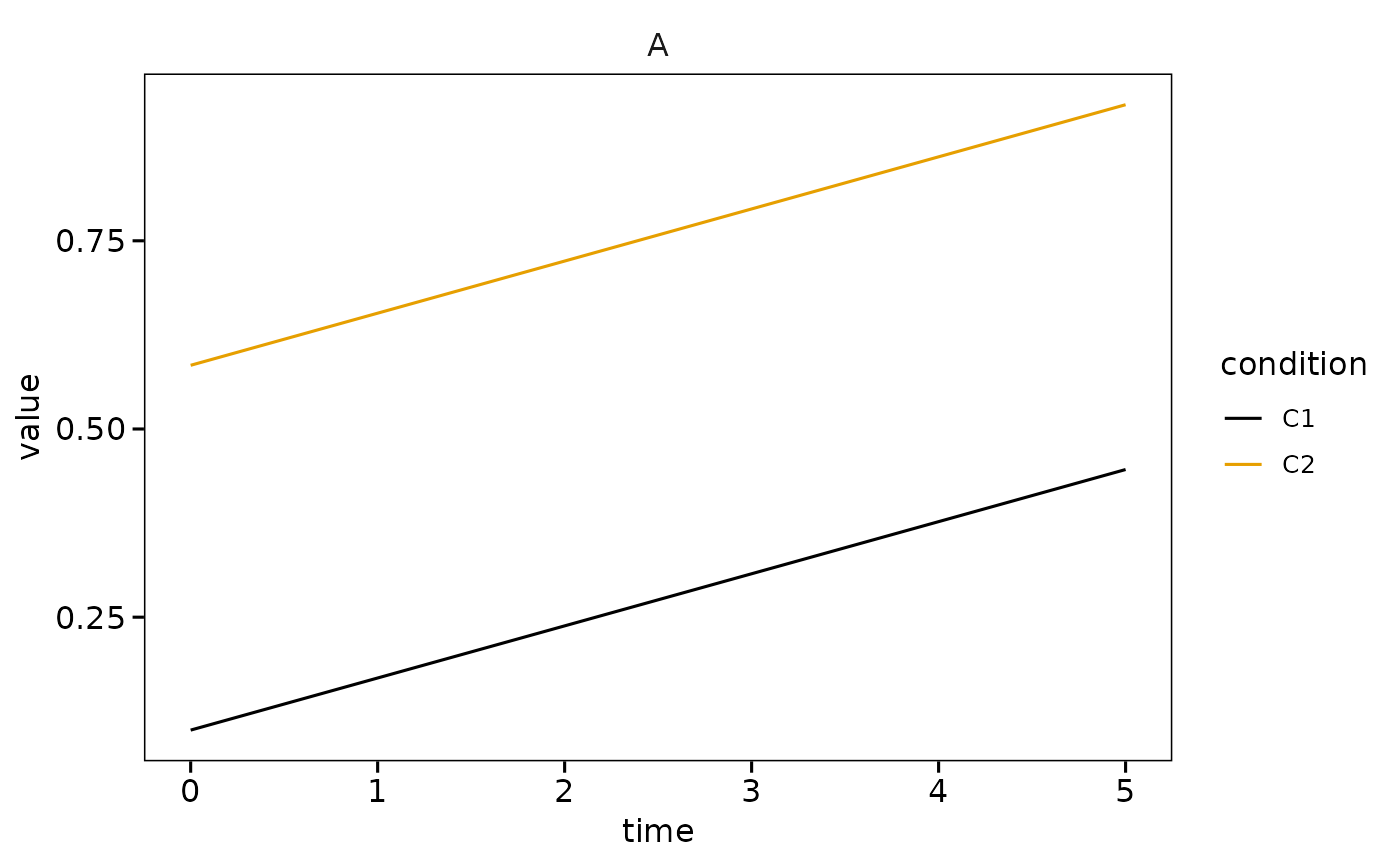
plot((x * p)(times, pars))
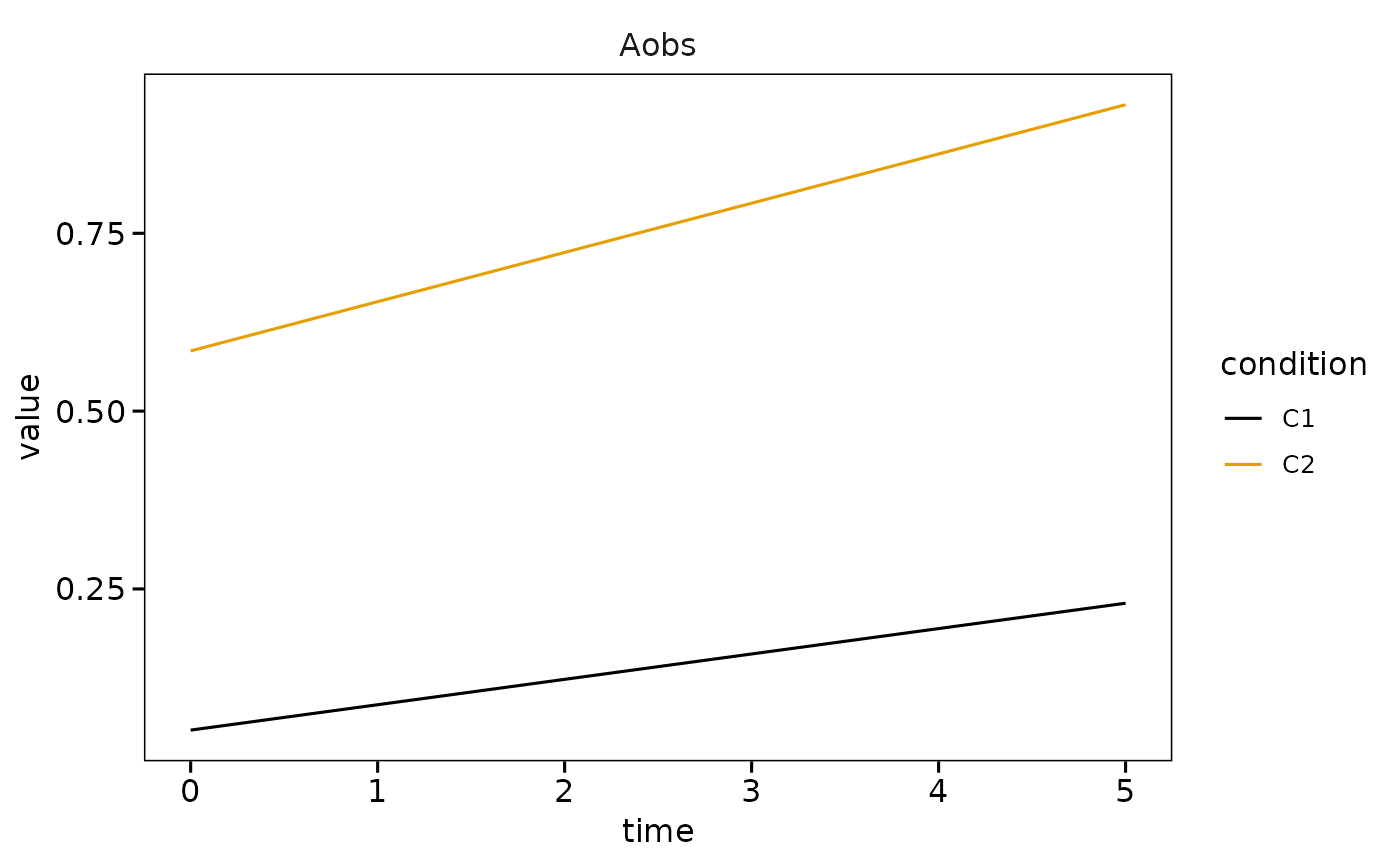
 plot((g * x * p)(times, pars))
 # }